

Walk-in and fitted wardrobes: layout, storage and ordering
Plan a wardrobe in Portugal: measure the space, compare ready-made and fitted systems, choose internal storage and agree the specification before ordering.

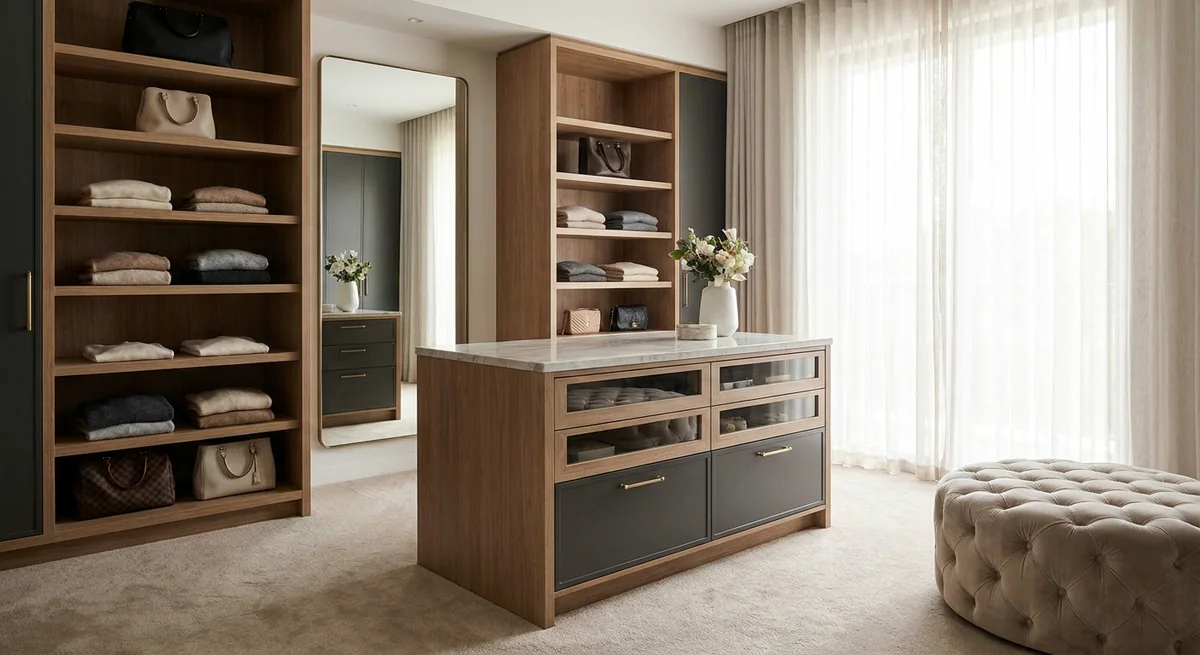
A wardrobe starts with the belongings it must hold and the space needed to use them. Layout, cabinet selection and internal fittings belong to the same process. An attractive exterior will not help if doors block the route or everyday clothes do not fit inside.
This guide focuses on the wardrobe area and its furniture. The home storage guide helps distribute belongings between rooms; here, the aim is to check a specific wardrobe before ordering.
List belongings and daily routines
Separate hanging and folded clothing, then record shoes, bags, linen and seasonal items. Consider what is used daily and whether two people need access to neighbouring sections at the same time. Allow spare capacity around your actual wardrobe, rather than a universal percentage.
Identify items better stored elsewhere. The dressing area does not need to accommodate every household object simply because a cupboard could be added.
Check the room and opening space
Record actual wall dimensions, heights, recesses and projections, along with windows, doors and connections. Show cabinet doors, extended drawers, access to shelves and space for changing. The cabinet footprint and the area needed to use it are separate checks.
If the wall has unresolved moisture or damage, establish the cause before installation. Fitted furniture does not solve a building problem. Confirm positioning and installation requirements with the manufacturer.
Compare ready-made, modular and fitted systems
- Ready-made wardrobes: check external dimensions and available interiors.
- Modular systems: review compatible sections, adjustments and components.
- Made-to-measure furniture: agree drawings, measurements, materials and the full specification.
- Open sections: consider visibility, cleaning and everyday organisation.
No format suits every room. Compare specific products, documentation, servicing and complete quotations. Do not rule out factory-made furniture solely because of a material name or the home's coastal location.
Approve the internal arrangement and fittings
Check shelf access, hanging positions and drawer dimensions. Confirm whether fronts, handles, internal components, lighting, delivery and assembly are included. A more expensive mechanism only adds value if it serves your needs.
Compare samples with flooring and adjacent furniture. Coordinate lighting and access to connections before manufacture. Fixings and installation must suit the selected system and the supporting surface.
Prepare the order specification
- Approved drawings, dimensions and section positions.
- Materials, finishes, samples and fitting references.
- Included work and components.
- Responsibility for final measurements and changes.
- Delivery, installation, acceptance and correction of discrepancies.
The wardrobe can form part of a wider home furnishing plan in Portugal. Prices and lead times should come from the agreed supplier scope, rather than a table of average figures.
Wardrobe questions
Do I need a separate dressing room?
Not necessarily. Compare your belongings, available space and layout options. A recess or cabinet may suit the task better.
Can existing sections stay?
Yes, if their condition, dimensions and use remain suitable. For a design consultation, send measurements, photographs and a belongings list. Decisions spanning several rooms can be coordinated in the interior design project.